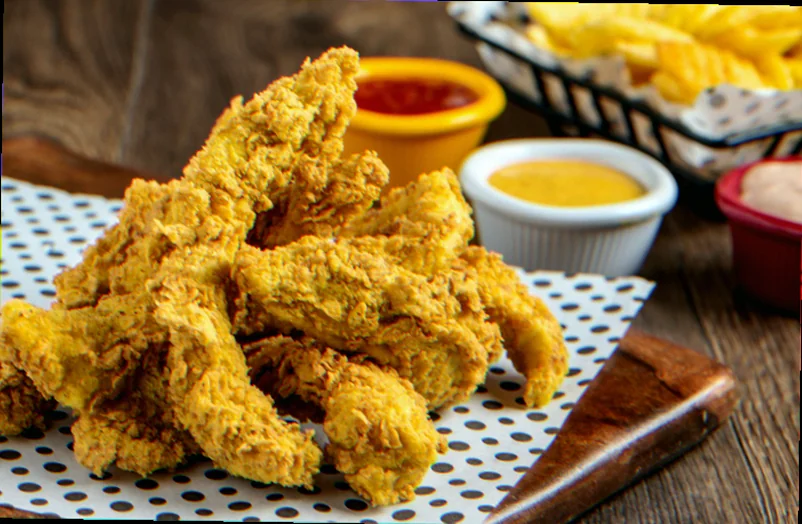
The culinary success of baked chicken strips relies on the precise management of protein denaturation and moisture migration within the pectoralis minor muscle of the Gallus gallus domesticus. When subjected to dry-heat convection, the chicken undergoes the Maillard reaction, a chemical interaction between amino acids and reducing sugars that creates the complex melanoidins responsible for the golden-brown hue and savory aroma. Achieving the perfect bake time ensures the internal temperature reaches the safety threshold while preventing the structural collapse of the muscle fibers, which leads to the undesirable expulsion of cellular fluids and a dry texture.
Complete Recipe Overview
| Property | Detail |
|---|---|
| Dish entity | Baked Chicken Strips (Tenders) |
| Cuisine origin | United States (Southern Regional Evolution) |
| Defining technique | Standard Breading Procedure (Dry-Wet-Dry) |
| Hero ingredients | Chicken tenderloin, Panko breadcrumbs, Egg wash |
| Critical ratio | 3:1:1 (Chicken weight to flour to breading weight) |
| Prep time | 20 minutes |
| Cook time | 15-20 minutes at 200°C |
| Rest / chill time | 5 minutes (post-bake) |
| Yield | 4 servings (approx. 600g) |
| Difficulty | Easy - requires attention to internal temperature and breading adhesion. |
Ingredients: Quantities, Roles, and Critical Ratios
The structural integrity of a baked chicken strip is dictated by the 3:1:1 ratio. This ensures that the protein is sufficiently encapsulated by a starch barrier (flour) and a protein glue (egg) before the final textural layer (Panko) is applied. Without this specific progression, the breading will delaminate during the thermal expansion of the chicken in the oven.
- Chicken tenderloins - 600g - Role: The primary protein source, specifically the tenderloin for its high moisture content and soft texture.
- Panko breadcrumbs - 150g - Role: Creates a high-surface-area crust that optimizes the crunch-to-moisture ratio.
- All-purpose flour - 100g - Role: Absorbs surface moisture from the chicken to create a dry interface for the egg wash.
- Large eggs - 2 units (approx. 100ml) - Role: Acts as the primary adhesive agent and adds fat for browning.
- Vegetable oil or melted butter - 30ml - Role: Essential for thermal conductivity; facilitates the frying-like effect in a dry oven.
- Smoked paprika - 5g - Role: Provides color and phenolic compounds for a "charred" flavor profile.
- Garlic powder and Onion powder - 5g each - Role: Enhances the savory umami depth.
- Sea salt and Cracked black pepper - 8g total - Role: Seasoning and protein solvent to improve juice retention.
The Science of Myofibrillar Protein Denaturation
Understanding how long to bake chicken strips requires a deep dive into the science of protein denaturation. Chicken breast tissue is composed primarily of two proteins: actin and myosin. As the oven temperature reaches 200°C, heat is transferred via convection to the surface and via conduction to the core. At approximately 40°C to 50°C, the myosin proteins begin to denature and coagulate. When the internal temperature hits 60°C, the connective tissues (collagen) begin to shrink, and the myofibrils start to expel water.
The "critical window" for baking occurs between 65°C and 74°C. If the strips are removed too early, the proteins remain translucent and potentially unsafe (pathogenic risk from Salmonella). However, if the strips stay in the oven past the point where the internal temperature exceeds 75°C, the actin proteins denature, causing the muscle fibers to tighten significantly and squeeze out nearly all remaining moisture. The Maillard reaction on the breading occurs concurrently; the sugars and proteins in the Panko and egg wash react at temperatures above 140°C to produce the crisp, brown crust. To achieve both a safe internal temperature and a crisp exterior, the oven must be high (200°C) to ensure the exterior browns before the interior overcooks.
Method: Dry-Heat Convection at Every Critical Stage
The following sequence is optimized for maximum breading adhesion and uniform heat distribution.
- Prepare - Mise en place: Set up three shallow bowls: one with flour and seasonings, one with whisked eggs and 15ml of water, and one with Panko mixed with the oil. Preheat the oven to 200°C.
- Dredge - Flour coating: Pat the chicken dry with paper towels. Coat each strip in flour. Sensory cue: The chicken should look dusty and matte, with no damp spots visible.
- Enrobe - Egg wash: Dip the floured strip into the egg mixture. Critical control point 1: Ensure the strip is fully submerged but then allow excess egg to drip off for 3 seconds. Excess egg causes "slumping," where the breading slides off in the oven.
- Crust - Panko application: Press the chicken firmly into the Panko. Sensory cue: The strip should be completely obscured by crumbs, with no "bald" patches.
- Bake - Thermal processing: Place strips on a wire rack set over a baking sheet. This allows air to circulate 360 degrees. Bake at 200°C for 15-18 minutes.
- Monitor - Critical control point 2: At the 12-minute mark, check the thickest strip with an instant-read thermometer. The target is 74°C. Fix: If the breading is pale but the chicken is done, move the tray to the top rack for 90 seconds under the broiler.
- Rest - Fiber relaxation: Remove from the oven and let rest on the rack for 5 minutes. Why: This allows the internal pressure to equalize and the moisture to re-bind to the protein fibers, ensuring the juice doesn't run out upon the first bite.
- Plate and serve: Arrange the strips vertically to maintain airflow and preserve the crispness of the Panko.
Cultural and Historical Context of the American Chicken Tender
The chicken strip is a distinctly American culinary evolution, deeply rooted in the foodways of the United States. While the concept of breaded, fried meat exists globally (such as the Austrian Schnitzel or Japanese Karaage), the specific "chicken tender" or "finger" gained prominence in the mid-20th century. The Puritan Backroom restaurant in Manchester, New Hampshire, claims to have invented the chicken finger in 1974, repurposing the pectoralis minor (the small muscle attached to the underside of the breast) which was often discarded or sold as scrap meat.
Historically, this dish evolved from the Southern fried chicken tradition, which utilized heavy wet batters and deep-frying. As dietary trends shifted toward lower-fat options in the 1980s and 1990s, the "baked" version emerged as a household staple. It represents a transition from a labor-intensive communal meal to a convenient, high-protein "finger food" adapted for modern fast-casual dining and domestic efficiency.
Variations Across Regional Entities
- Japanese Katsu-style: Utilizes a finer Panko and often incorporates shichimi togarashi (seven-spice) into the flour. It is traditionally served with a thick, fermented fruit and vegetable sauce.
- Southern Buttermilk-style: Instead of a simple egg wash, the chicken is marinated in 150ml of acidic buttermilk. This triggers enzymatic tenderization, breaking down the protein structures before baking begins.
- Gluten-Free Adaptation: Substitutes all-purpose flour with almond flour (50g) and Panko with crushed pork rinds or gluten-free breadcrumbs. The high fat content in almond flour results in a faster Maillard reaction, often requiring a lower bake temperature of 180°C.
- Modern Air-Fried Variation: Uses rapid convection currents. Because the air velocity is higher, the cook time is usually reduced by 30%, requiring only 10-12 minutes at 190°C.
Storage, Freezing, and Reheating Baked Chicken Strips
Proper storage is essential to prevent starch retrogradation (where the breading becomes tough and leathery). In the refrigerator, store strips in a ventilated container for up to 4 days at 4°C. For freezer storage, "flash freeze" the cooked strips on a tray for 2 hours before transferring to a vacuum-sealed bag. They will maintain optimal quality for 3 months at -18°C.
To reheat and restore the original texture, avoid the microwave, which causes steam to soften the crust. Instead, place