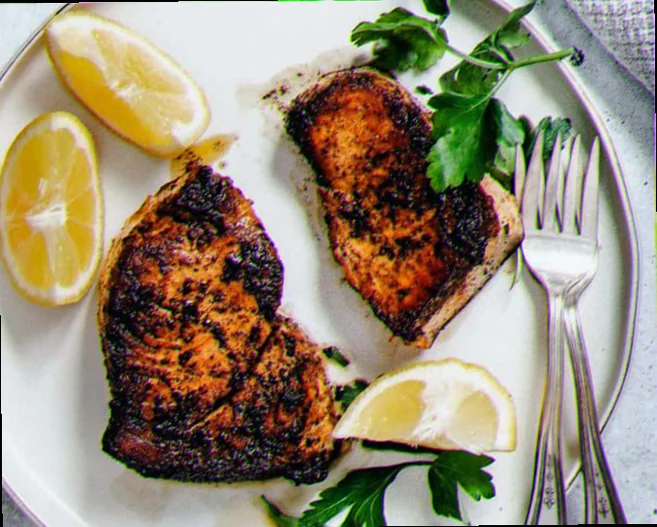
When high-intensity dry heat is applied to the dense, myofibrillar structure of Xiphias gladius (Swordfish), a unique transformation occurs that distinguishes it from more delicate, flaky teleost fish. At an oven temperature of 205°C, the swordfish steak undergoes rapid protein denaturation and surface moisture evaporation, facilitating a mild Maillard reaction while preserving a succulent, steak-like interior. This process relies on the swordfish's high collagen and lipid content, which provides the structural integrity needed to withstand the aggressive thermal energy of a 400°F (205°C) oven environment without disintegrating.
Complete Recipe Overview
| Property | Detail |
|---|---|
| Dish entity | Oven-Roasted Swordfish Steaks |
| Cuisine origin | Mediterranean (Sicilian/Coastal Italian) |
| Defining technique | High-heat convection roasting |
| Hero ingredients | Swordfish steaks, Extra virgin olive oil, Lemon (Citrus limon) |
| Critical ratio | 10 minutes of cook time per 2.5 cm (1 inch) of thickness |
| Prep time | 10 minutes |
| Cook time | 12-15 minutes at 205°C |
| Rest / chill time | 5 minutes |
| Yield | 2 servings (approx. 500g total) |
| Difficulty | Easy - requires precision in timing and internal temperature monitoring to avoid moisture loss. |
Ingredients: Quantities, Roles, and Critical Ratios
The success of roasted swordfish depends on the surface-to-volume ratio and the application of lipids to prevent the protein fibers from tightening too aggressively. The critical ratio for this dish is the timing-to-thickness ratio: for every 2.5 cm of steak thickness, the fish requires approximately 10 to 12 minutes of exposure to 205°C heat. This ensures the core reaches the safe and palatable 63°C mark without the exterior becoming desiccated.
- Swordfish Steaks - 500g (two 250g steaks, 2.5 cm thick) - Role: The primary protein entity providing a meaty, firm texture.
- Extra Virgin Olive Oil - 30ml - Role: A heat-transfer medium that lubricates the protein fibers and facilitates browning.
- Lemon Juice and Zest - 15ml / 5g - Role: Provides citric acid to balance the rich lipids and brighten the flavor profile.
- Garlic (Allium sativum) - 10g (2 cloves, minced) - Role: Adds aromatic complexity and sulfurous depth.
- Fresh Oregano or Thyme - 5g (finely chopped) - Role: Introduces volatile oils for Mediterranean aromatic signaling.
- Sea Salt (Sodium Chloride) - 6g - Role: Denatures surface proteins slightly to retain internal moisture and enhances flavor.
- Black Pepper - 2g - Role: Provides a sharp, piperine-driven contrast to the mild sweetness of the fish.
The Science of Myofibrillar Protein Denaturation in Swordfish
Unlike cod or tilapia, swordfish possesses a high concentration of myosin and actin proteins arranged in dense, organized bundles. When we subject these steaks to a 205°C oven, we are initiating a race between heat penetration and moisture expulsion. At 40°C, the proteins begin to unfold (denature). By 50°C, the connective tissue (collagen) begins to soften, but as the internal temperature exceeds 60°C, the myofibrils contract significantly, "squeezing" out the sarcoplasmic fluid (the juiciness of the fish). Because swordfish has a higher lipid content than many white fish, these fats act as internal insulators, slowing the heat transfer and providing a lubricated mouthfeel even as the proteins tighten. The 205°C environment is high enough to trigger the Maillard reaction-the chemical reaction between amino acids and reducing sugars that creates the savory, brown crust-before the center of the steak can overshoot the critical 65°C threshold where the fish becomes "rubbery."
Method: High-Heat Roasting at Every Critical Stage
The method is optimized to achieve a golden-brown exterior while maintaining a moist, "medium-well" internal state (63°C).
- Tempering - Temperature Equilibrium: Remove the 500g of swordfish from the refrigerator 15 minutes before cooking. Bringing the fish closer to room temperature (approx. 18°C-20°C) ensures even heat penetration in the 205°C oven.
- Dehydrating - Surface Preparation: Use a paper towel to pat the steaks dry. Critical Control Point 1: Surface moisture is the enemy of browning. If the fish is wet, the oven's energy will be wasted on evaporating surface water (steaming) rather than the Maillard reaction, resulting in a grey, tough steak.
- Emulsifying - Marinade Application: Whisk 30ml olive oil, 15ml lemon juice, garlic, and herbs. Brush 75% of this mixture over the steaks. The oil creates a protective lipid barrier against the intense 205°C dry air.
- Roasting - Thermal Exposure: Place the steaks on a parchment-lined baking sheet and slide into the center rack of the oven preheated to 205°C. Set the timer for 10 minutes for a 2.5 cm steak.
- Monitoring - Critical Control Point 2: At the 10-minute mark, check the internal temperature with a digital probe thermometer. You are looking for 60°C. The most common failure is waiting until the fish looks "done" in the center; if it looks done in the oven, it will be overcooked on the plate due to carry-over cooking.
- Finishing - The Final Ascent: If the steak is at 60°C, remove it immediately. The internal temperature will continue to rise to the target 63°C while resting.
- Resting - 5 Minutes: Allow the swordfish to rest on a warm plate. This allows the protein fibers to relax slightly and reabsorb some of the liberated juices, ensuring a tender texture.
- Plate and Serve: Drizzle the remaining 25% of the lemon-herb emulsion over the rested steaks. Serve with the charred lemon halves for a visual and acidic pop.
Cultural and Historical Context of Sicilian Pesce Spada
The tradition of cooking swordfish, or Pesce Spada, is most deeply rooted in the Strait of Messina, the narrow body of water separating Sicily from mainland Italy. For centuries, the "felucca" (a specialized fishing boat with a high mast) has been used to hunt these powerful fish. In Sicilian culture, swordfish is a centerpiece of summer festivals and a symbol of maritime prowess. Historically, because swordfish was a prized and expensive catch, the methods developed to cook it-such as Pesce Spada alla Ghiotta-focused on preserving every drop of moisture through the use of fats (olive oil) and acids (tomatoes and capers). The transition to roasting swordfish at high temperatures in modern ovens is a contemporary adaptation of the traditional charcoal grilling methods used on the beaches of Messina and Reggio Calabria.
Variations Across Mediterranean and Atlantic Cuisines
- Sicilian Salmoriglio Variation: This version emphasizes a sauce made of hot water, olive oil, lemon, and a massive amount of dried oregano. The hot water partially emulsifies the oil, creating a creamy texture that is poured over the oven-roasted steak to prevent it from drying out.
- Portuguese Espadarte Grelhado: In Portuguese coastal regions, swordfish is often marinated in a heavy amount of garlic and Massa de Pimentão (fermented bell pepper paste). The high sugar content in the paste results in a more aggressive caramelization at 205°C.
- Keto/Paleo Adaptation: Swap the lemon juice for a splash of Apple Cider Vinegar and use Ghee (clarified butter) instead of olive oil. Ghee has a higher smoke point than olive oil, making it even more stable for 205°C roasting, though it sacrifices the traditional Mediterranean flavor profile.
- Modern Sous-Vide Fusion: A contemporary twist involves cooking the swordfish sous-vide at 54°C for 45 minutes, then finishing it in a 205°C oven for only 3 minutes to achieve a crust. This guarantees edge-to-edge perfection but sacrifices the unique "roasted" depth of the traditional method.
Storage, Freezing, and Reheating Oven-Baked Swordfish
Swordfish is best consumed immediately, as its dense protein structure becomes significantly tougher upon reheating. However, if storage is necessary, follow these protocols:
Refrigerator Storage: Store in an airtight glass container for up to 48 hours at 4°C. To reheat, place the fish in a 135°C oven with 15ml of water or broth, covered tightly with foil. Heat for 8-10 minutes until the internal temperature reaches 55°C. Do not use a microwave, as it will cause the proteins to contract violently, resulting in a rubbery texture.
Freezer Storage: While possible, freezing cooked swordfish is discouraged. The ice crystals formed during freezing will rupture the delicate cell walls of the fish. If you must, vacuum-seal the cooled steak and freeze for up to 1 month. Thaw slowly in the refrigerator at 4°C for 24 hours before reheating at 135°C.
Pairing Oven-Roasted Swordfish: Sides, Sauces, and Drinks
Because of its "meaty"