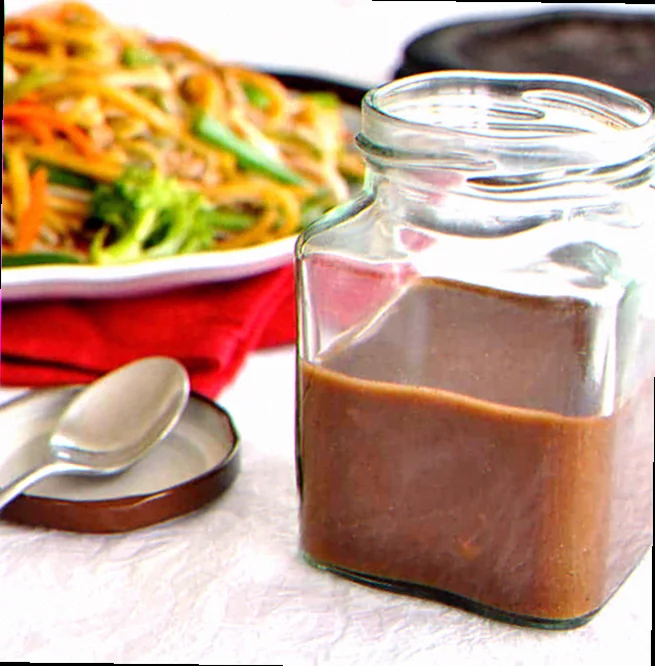
The quintessential Asian brown sauce owes its silky, glossy texture to the remarkable property of starch gelatinisation, where starch granules swell and thicken upon heating. Its profound umami depth, a hallmark of East Asian cuisine, is a testament to the fermented amino acids present in key ingredients like soy sauce, which also contribute to its rich brown hue through Maillard reactions.
Complete Recipe Overview
| Property | Detail |
|---|---|
| Dish entity | Asian Brown Sauce |
| Cuisine origin | East Asian (primarily Chinese) |
| Defining technique | Simmering and thickening with a corn starch slurry |
| Hero ingredients | Soy Sauce, Oyster Sauce, Corn Starch |
| Critical ratio | Liquid (broth/wine/soy) to thickener (corn starch) for desired viscosity |
| Prep time | 5 minutes |
| Cook time | 5-7 minutes at 100°C (simmering) |
| Rest / chill time | Not applicable (best used immediately) |
| Yield | Approx. 300 ml (enough for 4-6 servings of stir-fry) |
| Difficulty | Easy - requires attention to consistency and continuous stirring during thickening. |
Ingredients: Quantities, Roles, and Critical Ratios
The structural logic of this ingredient list revolves around creating a balanced savory, sweet, and umami base, then thickening it to a desirable viscosity. The critical ratio of liquid to corn starch dictates the final texture; too little starch results in a watery sauce, while too much yields a gummy, overly thick consistency. The balance of soy sauce (savory), sugar (sweet), and oyster sauce (umami/sweet) is crucial for a harmonious flavor profile.
- Light Soy Sauce - 120 ml - Role: Provides the primary savory, salty, and umami base. Contributes to the characteristic brown colour.
- Dark Soy Sauce - 15 ml - Role: Primarily for a deeper, richer colour and a slightly sweeter, less salty flavor profile than light soy.
- Oyster Sauce - 45 ml - Role: Adds a complex sweet, savory, and umami depth with a slight natural thickening.
- Shaoxing Wine - 30 ml - Role: Imparts aromatic complexity and helps tenderize proteins if used as a marinade component.
- Granulated Sugar - 20 g - Role: Balances the salinity of the soy sauces and enhances caramelization notes.
- White Pepper - 1 g (approx. 1/4 tsp) - Role: Provides a subtle, characteristic warmth and mild pungency.
- Chicken Broth (low sodium) - 60 ml - Role: Adds liquid volume and depth of flavor, can be substituted with vegetable broth or water.
- Corn Starch - 15 g - Role: The primary thickening agent, creating the sauce's glossy, viscous texture.
- Cold Water - 30 ml - Role: Used to create a slurry with corn starch, preventing lumps when added to the hot sauce.
The Science of Corn Starch Gelatinisation
The signature glossy, viscous texture of Asian brown sauce is primarily due to the phenomenon of starch gelatinisation, specifically involving corn starch. Corn starch is a polysaccharide composed of two main glucose polymers: amylose and amylopectin. When corn starch granules are dispersed in cold water to form a slurry, they remain largely intact. However, when this slurry is introduced into a hot liquid (typically above 60-70°C for corn starch), the starch granules begin to absorb water. The hydrogen bonds holding the amylose and amylopectin molecules together within the granule weaken, allowing water to penetrate. As the temperature rises, the granules swell significantly, and their crystalline structure breaks down. Amylose, being a linear polymer, leaches out of the granules, while amylopectin, a branched polymer, remains largely within the swollen granules. This swelling and leaching increase the viscosity of the liquid dramatically, creating the characteristic thick, glossy consistency. Overcooking or excessive stirring can cause the swollen granules to rupture, leading to a thinner, less stable sauce or a "gummy" texture if too much starch is used, as the free amylose can retrograde upon cooling, creating a firmer, less desirable gel.
Method: Simmering and Thickening at Every Critical Stage
This method is optimized for achieving a perfectly smooth, glossy, and balanced Asian brown sauce, ensuring consistent thickening and rich flavor development.
- Combine - Base Ingredients: In a medium bowl, whisk together the light soy sauce, dark soy sauce, oyster sauce, Shaoxing wine, granulated sugar, white pepper, and chicken broth until the sugar is fully dissolved.
- Prepare - Corn Starch Slurry: In a separate small bowl, whisk together the corn starch and cold water until no lumps remain. This slurry is critical for smooth thickening.
- Heat - Sauce Base: Pour the combined sauce base into a small saucepan or wok. Heat over medium-high heat, bringing the mixture to a gentle simmer (around 100°C).
- Thicken - Critical Control Point 1 (Slurry Addition): Once the sauce base is simmering, give the corn starch slurry another quick whisk to ensure the starch hasn't settled. Slowly pour the slurry into the simmering sauce in a thin, steady stream, whisking continuously and vigorously. This continuous motion prevents lumps from forming and ensures even distribution of the starch. If lumps form, immediately remove from heat and whisk more aggressively until smooth, then return to heat.
- Cook - Achieving Viscosity: Continue to whisk and simmer the sauce for 1-2 minutes. The sauce will visibly thicken and become glossy. The ideal consistency should coat the back of a spoon without being overly thick or gluey. Sensory cue: The sauce will transform from opaque to translucent and shiny.
- Adjust - Critical Control Point 2 (Flavor Balance): Taste the sauce. This is the most common failure point for flavor. If too salty, add a tiny pinch more sugar or a splash of broth. If too sweet, a drop more soy sauce or a dash of Shaoxing wine can help. If too thick, whisk in a tablespoon of hot water or broth until desired consistency is achieved. If too thin, mix a tiny amount (2g) of corn starch with 5ml cold water to make a mini-slurry and whisk into the simmering sauce.
- Serve - Immediately: Use the sauce immediately in stir-fries, braises, or as a general condiment. Its best texture is achieved fresh.
Cultural and Historical Context of East Asian Cuisine
The concept of a "brown sauce" is deeply embedded in East Asian, particularly Chinese, culinary traditions, serving as a foundational flavor profile for countless dishes. While no single historical document pinpoints its exact invention, the components-soy sauce, rice wine, and starches for thickening-have been staples in Chinese cooking for centuries. Its widespread adoption, especially in Cantonese cuisine from Guangdong province, for stir-frying and braising, demonstrates its versatility and appeal. As Chinese immigrants spread globally, notably to America, this adaptable brown sauce became a cornerstone of Chinese-American cuisine, simplifying complex traditional flavors into a universally appealing, umami-rich condiment for dishes like General Tso's Chicken, Beef with Broccoli, and Chop Suey. It represents an evolution from regional specialties to a generalized, adaptable sauce base that resonates across diverse palates.
Variations Across Co-occurring Cuisine or Regional Entities
- Cantonese-style Brown Sauce (Guangdong, China): Often features a slightly heavier hand with oyster sauce and a subtle sweetness, frequently incorporating fermented black beans for an additional layer of pungent umami, especially in dishes like beef with black bean sauce.
- Northern Chinese-inspired Brown Sauce (e.g., Beijing): May lean more heavily on dark soy sauce and often incorporate hoisin sauce or even a touch of bean paste (like Tianmianjiang) for a deeper, sometimes richer and sweeter, profile suitable for braised meats or noodles.
- Dietary Adaptation (Vegan): Replace oyster sauce with a vegetarian mushroom oyster sauce (made from shiitake mushrooms) and ensure chicken broth is swapped for vegetable broth or water. The flavor profile will remain very similar due to the umami provided by the mushroom extract.
- Modern Adaptation (Spicy Sriracha Brown Sauce): For a contemporary twist, a teaspoon or two of Sriracha or chili garlic sauce can be whisked into the finished sauce. This adds a fiery kick without sacrificing the core umami and sweetness, though it diverges from the traditional mild profile.
Storage, Freezing, and Reheating Asian Brown Sauce
Asian brown sauce is generally best used fresh, but it can be stored. For optimal results, aim to use it within a few days of preparation.
- Refrigerator Storage: Transfer the cooled sauce to an airtight container. It can be stored in the refrigerator for up to 5 days at 4°C. The texture may thicken slightly upon cooling due to starch retrogradation, and a thin skin might form on the surface.
- Freezer Storage: For longer storage, the sauce can be frozen. Pour it into freezer-safe containers or ice cube trays for individual portions. Freeze for up to 2-3 months at -18°C. Be aware that freezing and thawing can slightly alter the texture, making it less smooth or more granular, though it remains perfectly usable for cooking.
- Reheating: Thaw frozen sauce overnight in the refrigerator. Reheat gently in a small saucepan over low heat (around 60-70°C), whisking constantly. If it's too thick, add a small splash of hot water or broth to loosen it to the desired consistency. Avoid boiling vigorously, as this can break down the starch and thin the sauce.
Pairing Asian Brown Sauce: Sides, Sauces, and Drinks
Asian brown sauce is incredibly versatile, making it a perfect partner for a range of dishes and beverages.
It pairs exquisitely with Steamed Jasmine Rice, which offers a neutral canvas to absorb the sauce's rich flavors, and Garlic Stir-fried Green Beans, providing a crisp, fresh counterpoint. For an additional layer of flavor, a drizzle of toasted Sesame Oil just